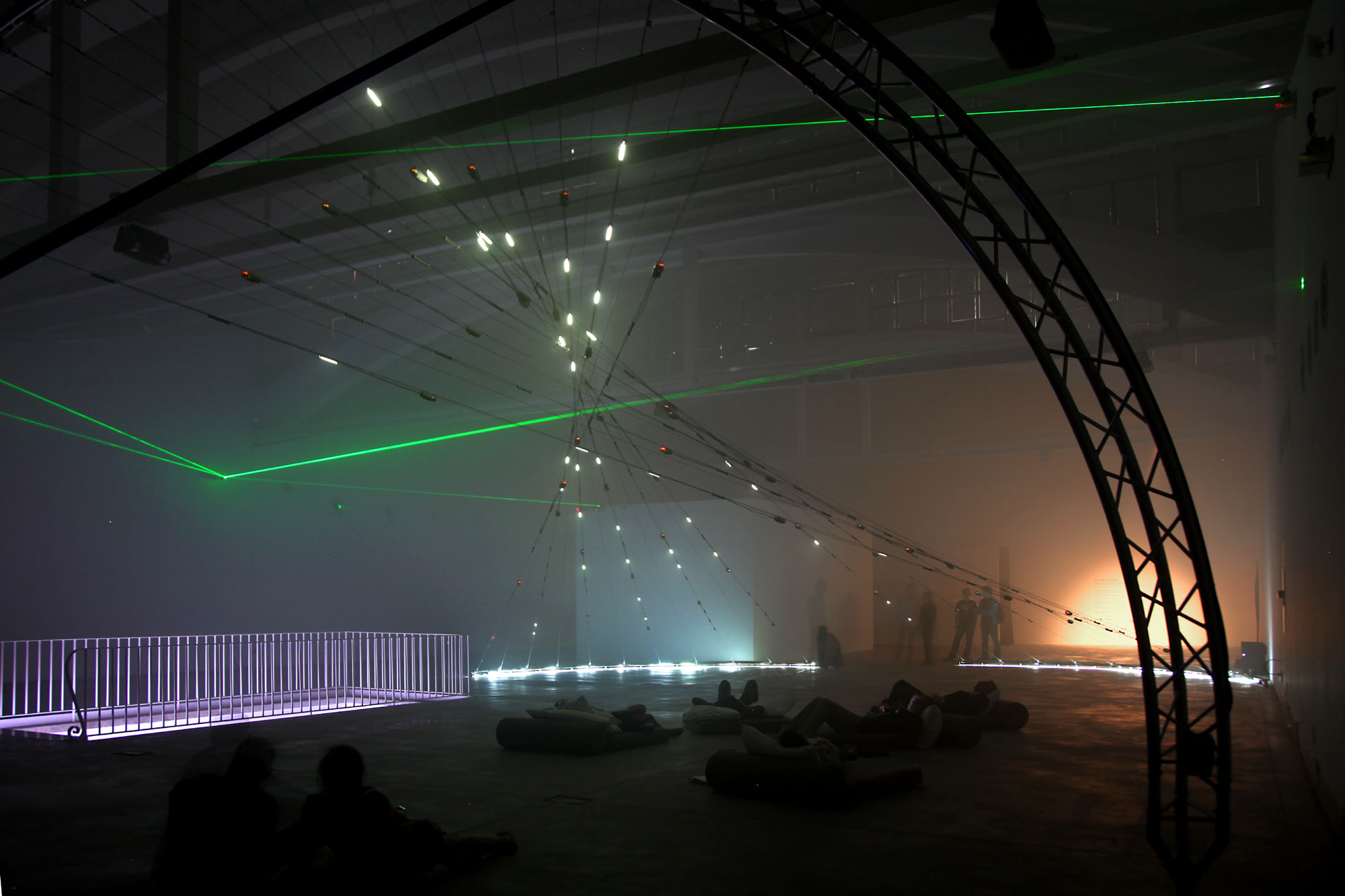
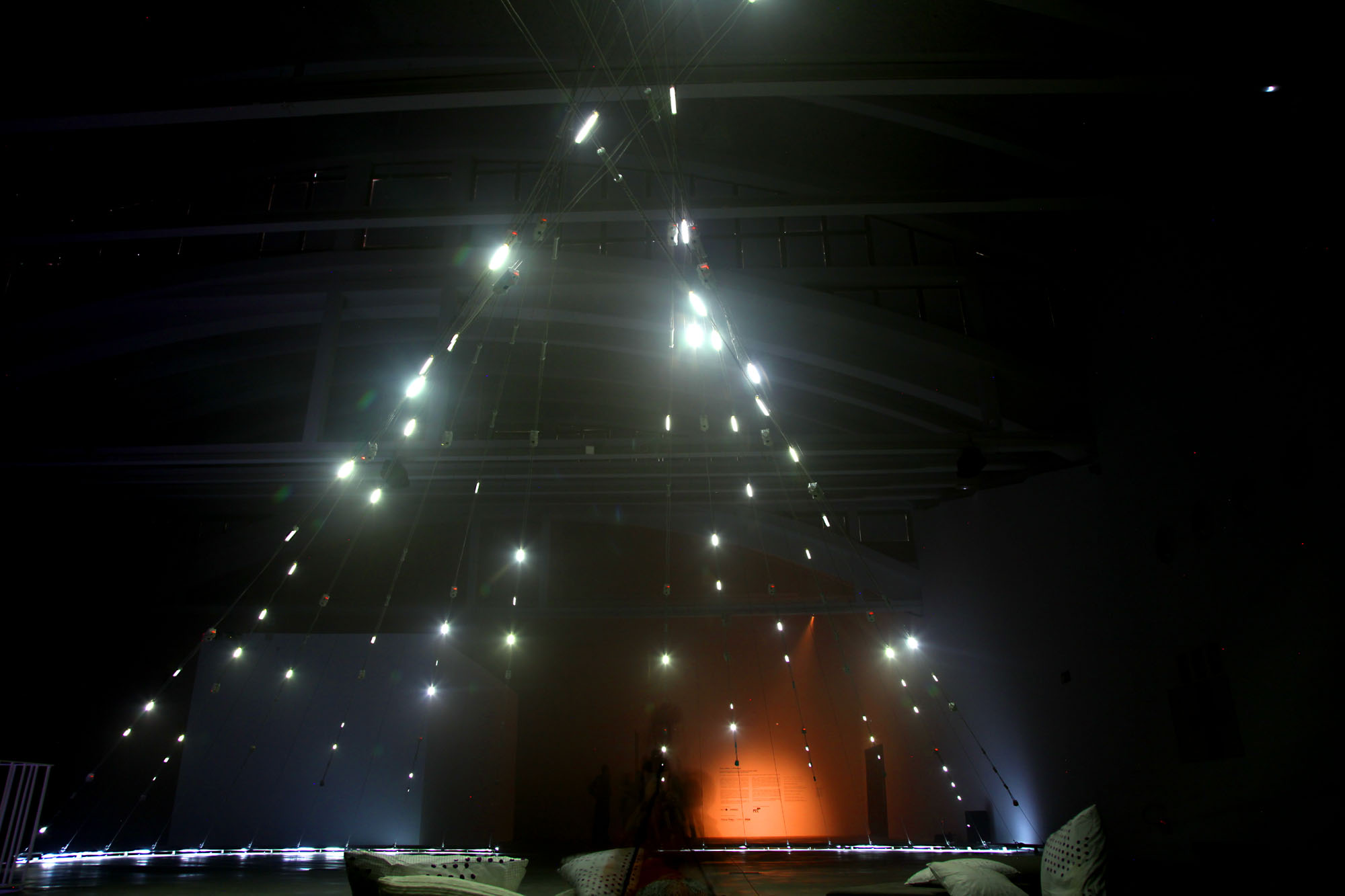
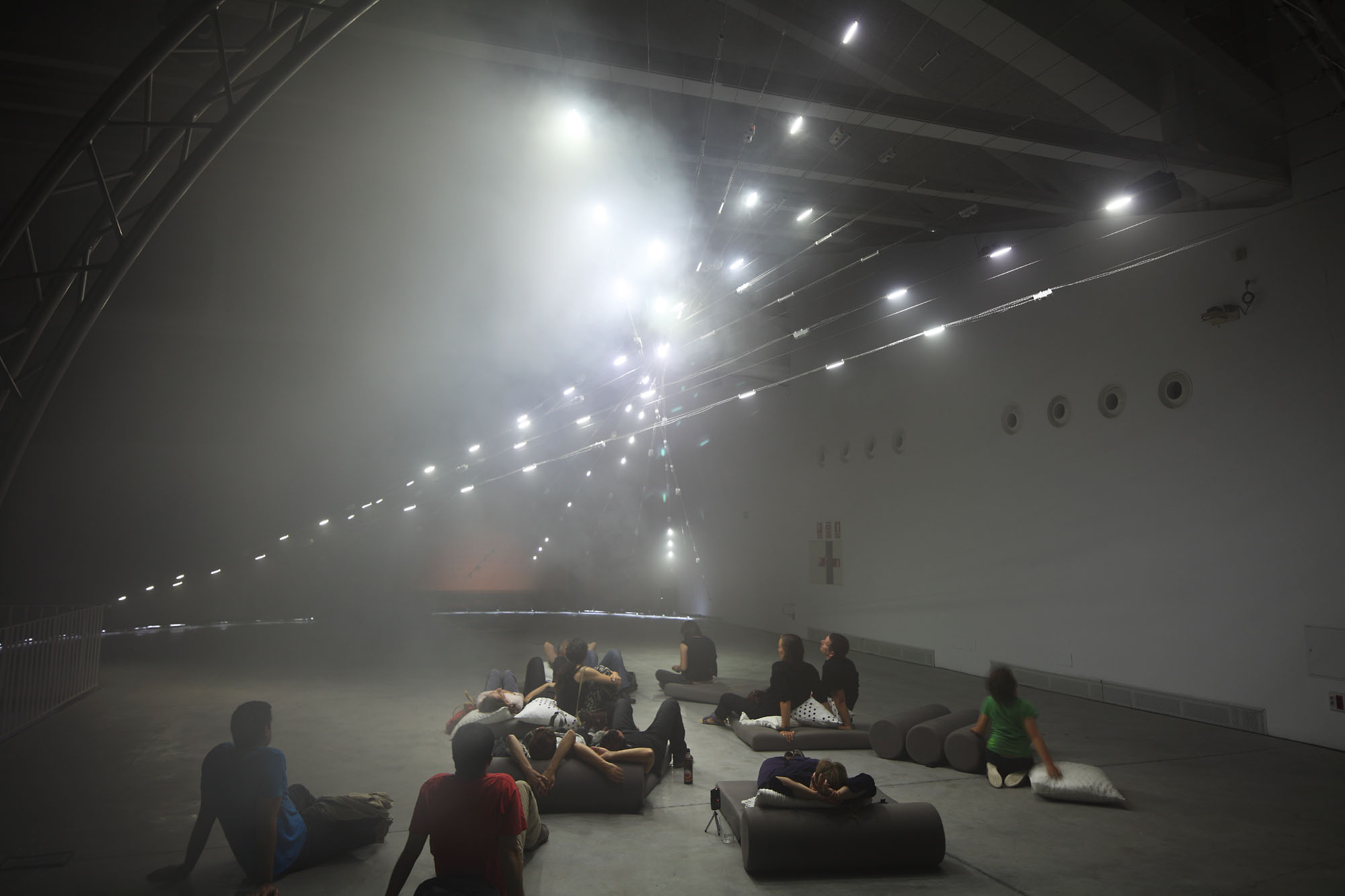
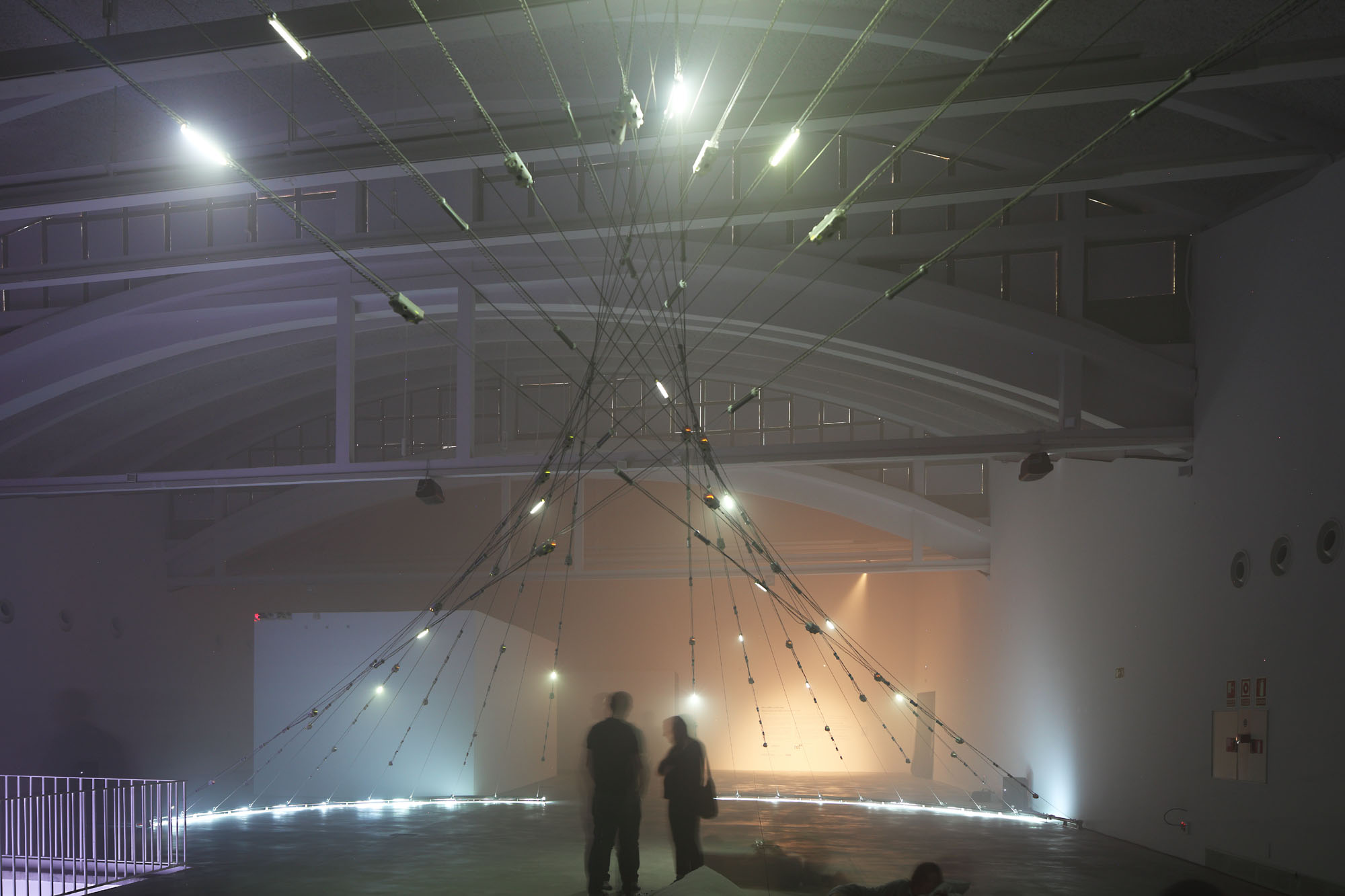
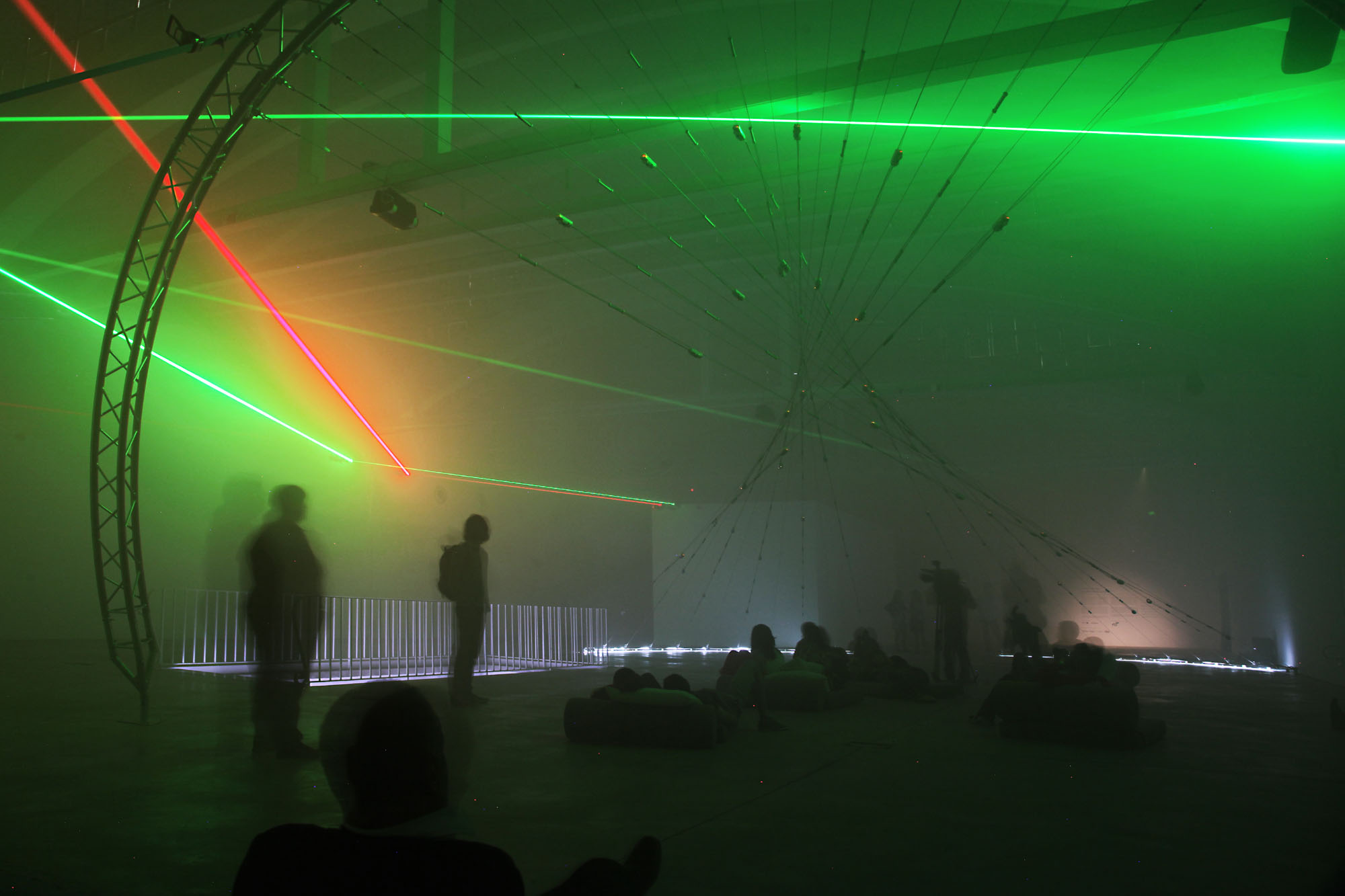
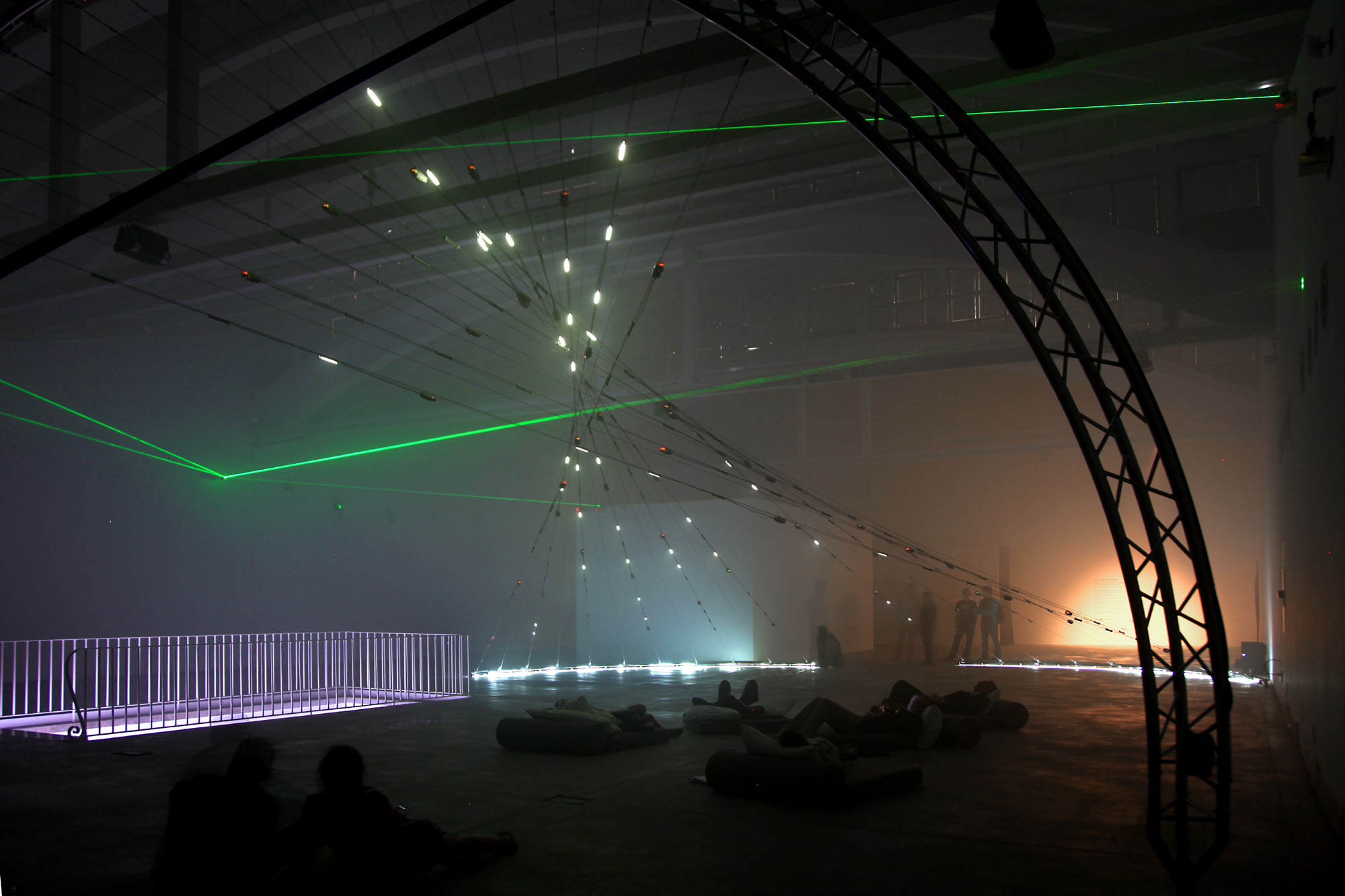
N-Polytope: Behaviors in Light and Sound After Iannis Xenakis is a light and sound performance-installation combining lighting, lasers, sound, sensing and machine learning software inspired by composer Iannis Xenakis’s Polytopes works from the 1960s and 70s: large scale, immersive architectural environments that made the indeterminate and chaotic patterns and behaviour of natural phenomena experiential through the temporal dynamics of light and the spatial dynamics of sound. The Polytopes still to this day are relatively unknown, but were far ahead of their time. N-Polytope is an attempt to both re-imagine Xenakis’ work with probabilistic/stochastic systems with new techniques as well as to explore how these techniques can exemplify our own historical moment of extreme instability.
The re-imagining runs in both 15 minute performance and continuously evolving installation modes. The system is steered through a custom developed wireless sensor network utilizing machine learning techniques, specifically from the research area of reinforcement learning in which software agents interact with their environment in order to achieve a goal. The agent seeks to achieve its goal despite the fact that there is a high degree of uncertainty about the environment – in other words, the agent doesn’t know until it does something and is then “rewarded” in either a positive or negative manner. In N-Polytope, agents receive sensor-actuator information from the environment (the brightness of an LED and the frequency/amplitude of a sound) and can either turn the LED or the sound on or off, receiving a reward for it. However, the environment around the agent (and the sensor) is continually changing, which makes it challenging to determine what steps the agent will take and what such actions will result in. The agent’s actions thus influence not only the state of the environment in the present but also can affect the environment’s state in the future.
The overall course of N-Polytope is that of an event that is partially scripted and partially indeterminate thus enabling the performance to continually move between order and disorder, tranquility and thundering chaos. The audience “feels” these algorithms as two forms of “life” – the behaviours in light and sound and the “life” of experiencing such a system evolving in the present.
N-Polytope was awarded an honourable mention in the 14th VIDA Art and Artificial Life Award from Fundacion Telefonica.


Location
LABoral Centro de Arte y Creación Industrial
Gijón, Spain
Premiere, July 20, 2012
Material
Custom designed architectural structure of steel and aluminum
LED's and custom electronics
Lasers and custom electronics
Custom designed control software
Photoelectric sensors
wireless Xbee modules and custom wireless sensor network software (http://sensestage.eu)
Collaborators
Concept and Direction: Chris Salter
Composition: Chris Salter and Adam Basanta
Architectural Design: Thomas Spier
Lighting and Laser System Design: Elio Bidinost
Embedded Systems, Micro Light and Sound Design, Media
Composition Programming: Marije Baalman
Media Behavior Modeling and Programming: Sofia Audry
Structural Consultant: Schlaich Bergermann and partner/David Sommer
Electronics Assembly: Rene Wassenburg (Schrikdraad Ontwerp) and Stan Verberkt
Openframeworks Laser Mirror Control Software: Samuel Tissot-Jobin